Description
Semax 5 mg: Research & Product Information
Product Overview
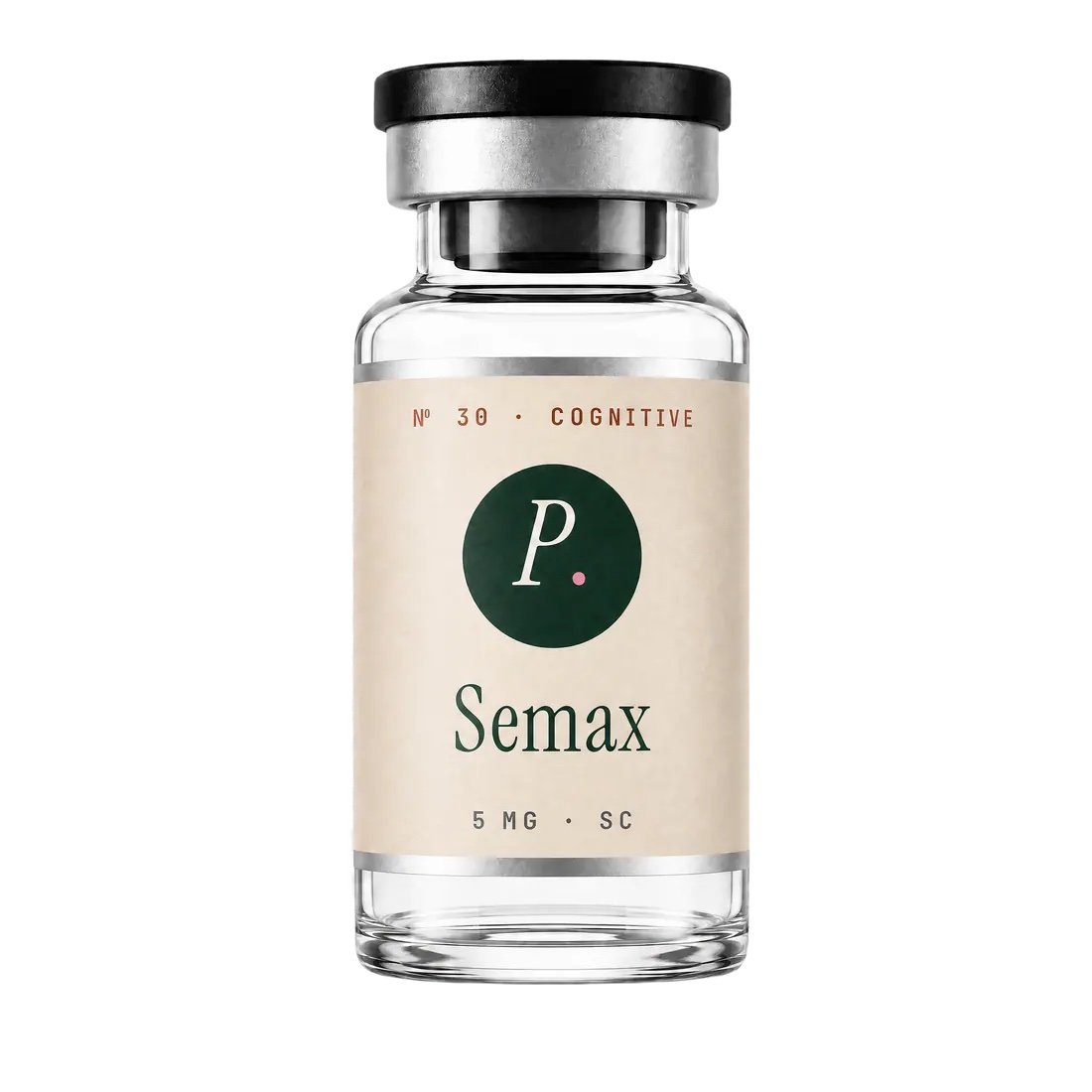
Semax 5 mg is a product listing identifying Semax, a synthetic heptapeptide derived from a fragment of adrenocorticotropic hormone (ACTH). The compound has been investigated in neurological research, including studies exploring cerebral ischemia, nervous-system signaling, and selected cognitive or behavioral outcomes.
Semax has attracted scientific interest because of its molecular structure and proposed interactions with pathways involved in neuronal function. However, the existence of published research does not establish that every product marketed as Semax is safe or effective, or that it provides a proven benefit for memory, focus, learning, mood, or cognitive performance.
This page provides an informational overview of Semax, its research background, the stated product quantity, and relevant quality and regulatory considerations. It does not establish that the listed product is an approved medicine or suitable for human use.
What Is Semax?
Semax is a synthetic heptapeptide commonly described as an ACTH(4–10) analogue. Its amino-acid sequence is Met-Glu-His-Phe-Pro-Gly-Pro, often abbreviated as MEHFPGP.
Unlike full-length ACTH, Semax is a short peptide fragment developed for investigation of biological activity associated with neurological research. Its molecular structure has been examined in experimental studies involving neuronal signaling and pathways associated with neurotrophic factors.
A proposed mechanism does not automatically establish a clinically meaningful effect. Research findings depend on the experimental model, the specific formulation tested, the population studied, and the outcomes measured.
Semax Research Background
Neurological research
Semax has been investigated in experimental and clinical research involving neurological conditions, including ischemic stroke and other selected nervous-system disorders. Some studies have reported outcomes of interest, but study quality, size, design, and independent replication influence how confidently those findings can be applied.
Research involving a particular clinical formulation should not automatically be transferred to a product sold through a different supply chain or with a different formulation.
Neurotrophic signaling
Preclinical research has examined possible relationships between Semax and pathways associated with neurotrophic factors, including brain-derived neurotrophic factor (BDNF). These findings may help inform further investigation into the compound’s biological activity.
However, proposed biological mechanisms and changes in laboratory measurements do not by themselves prove that a product improves neurological function or produces a meaningful benefit in humans.
Cognitive research
Semax is sometimes marketed online as a nootropic or cognitive-enhancement peptide. Research has explored selected cognitive and neurological outcomes, but the available evidence does not justify treating broad claims about memory, attention, learning, or productivity as established facts.
Claims about cognitive performance should be supported by appropriately designed human studies that examine the specific outcome, population, formulation, and intended use in question.
What the Human Evidence Can and Cannot Establish
Human studies of Semax have been reported, particularly in Russian medical literature. Some have investigated neurological conditions, while smaller studies have examined outcomes in healthy volunteers.
The existence of these studies is relevant, but it should not be confused with a large, independently replicated clinical evidence base. Differences in study design, reporting, clinical setting, and formulation limit how broadly the findings can be generalized.
For accurate product information, distinguish between:
- Preclinical research: Laboratory and animal experiments that investigate biological activity.
- Human research: Studies involving people, which must be evaluated for design, sample size, comparators, outcomes, and limitations.
- Clinical effectiveness: Evidence that establishes a meaningful benefit for a defined condition or population.
- Product-specific evidence: Evidence relating to the identity, quality, formulation, and performance of the actual product being listed.
Findings from one research preparation do not automatically verify the quality or clinical performance of every product sold under the Semax name.
Listed Product Information
| Attribute | Listed information |
|---|---|
| Product name | Semax 5 mg |
| Identified compound | Semax |
| Listed quantity | 5 mg |
| Product category | Research-peptide information |
The 5 mg quantity is the amount stated in the product name. It is not a dosing recommendation, a verified concentration, or independent confirmation of the product’s actual contents.
The product name alone does not establish its precise chemical form, excipients, formulation, sterility, stability, intended route, or analytical quality. These attributes require appropriate product-specific documentation.
Quality, Testing & Documentation
Clear documentation helps researchers understand what a product has been tested for and what the results can support.
Where available and applicable, relevant documentation may include:
- Identity testing: Analytical evidence supporting the identity of the material as Semax.
- Content analysis: Testing that supports the stated quantity.
- Purity and impurity information: Analytical findings, relevant impurities, and the limitations of the methods used.
- Batch-specific documentation: A certificate of analysis (COA) linked to the actual product batch or lot.
- Formulation information: Documentation identifying the chemical form and any other declared ingredients.
- Stability information: Product-specific evidence supporting any stated shelf life or storage conditions.
- Relevant microbiological testing: Where appropriate to the product and its classification, documentation addressing sterility and endotoxin status.
High-performance liquid chromatography (HPLC) is one technique used to separate and measure components in a sample. An HPLC result alone does not necessarily establish complete molecular identity, sterility, endotoxin status, stability, or suitability for human administration.
Peptika should publish claims about independent testing, purity percentages, or downloadable batch certificates only when current, verifiable documentation supports those statements. General information about a supplier’s testing procedures is not a substitute for evidence linked to the actual product batch.
Safety & Regulatory Considerations
Semax should not be presented as an established treatment for cognitive enhancement or a neurological condition on the basis of preliminary research, proposed mechanisms, or online marketing claims.
The US Food and Drug Administration (FDA) has identified potential immunogenicity concerns for compounded products containing Semax, including concerns associated with aggregation and peptide-related impurities. The FDA has also described gaps in available safety information for the relevant compounding contexts.
These regulatory safety concerns do not establish that every material sold as Semax is identical. They do mean that product identity, quality, formulation, and safety should not be assumed from the name or listed quantity alone.
Semax is not FDA-approved as a drug in the United States. A registration or authorization for a particular formulation in another country does not authorize every Semax product in every jurisdiction.
This page is informational and does not provide medical advice, dosing, reconstitution, injection, or self-administration instructions.
Frequently Asked Questions
What is Semax 5 mg?
Semax 5 mg is a product listing identifying Semax, a synthetic heptapeptide derived from an ACTH fragment, with a stated quantity of 5 mg. The label quantity does not independently verify the product’s identity, purity, formulation, or quality.
What has Semax been researched for?
Published research has investigated Semax in neurological contexts, including ischemic stroke and selected nervous-system outcomes. The available evidence varies in quality and does not establish broad effectiveness for every proposed use.
Does Semax improve memory or focus?
The product name does not establish a cognitive benefit. Some studies have explored cognitive or neurological outcomes, but those findings should not be generalized into a guarantee that Semax improves memory, attention, learning, or mental performance in healthy people.
Is Semax FDA-approved?
Semax is not FDA-approved as a drug in the United States. Regulatory status differs by country and specific formulation, so the status of a particular medicine elsewhere should not be interpreted as approval of this product.
Does a certificate of analysis prove that Semax is safe?
No. A COA supports only the conclusions justified by the sample and tests documented. It does not automatically establish clinical safety, effectiveness, sterility, stability, or suitability for human use.
What does HPLC testing show?
HPLC is an analytical method used to separate and measure components in a sample. Its conclusions depend on the method, reference standards, sample preparation, and results. HPLC alone should not be interpreted as proof of sterility or complete product quality.
Does the 5 mg label indicate a dose?
No. The listed quantity is product information, not a recommendation for use. This page does not provide dosing or administration guidance.
Does the product name establish the route of administration?
No. The name and quantity alone do not establish the formulation or route. Those details must be supported by accurate product documentation and any applicable regulatory authorization.
Conclusion
Semax 5 mg is a research-peptide listing involving a synthetic ACTH-fragment analogue with a history of neurological investigation. A credible product page should explain the compound’s research background, acknowledge the limitations of the human evidence, and distinguish the stated quantity from verified product quality.
For Peptika Store, accurate scientific language, transparent documentation, and careful regulatory wording provide a stronger foundation for trust than unsupported promises about cognitive enhancement, memory, or neurological benefits.
Research-use disclaimer: This page is provided for informational and research-literacy purposes only. It is not medical advice and does not establish that the product is approved or suitable for human or veterinary use. Do not use this description as a guide to dosing, reconstitution, injection, or self-administration. Follow applicable laws, institutional requirements, and relevant safety procedures.
Reviews
There are no reviews yet.