Description
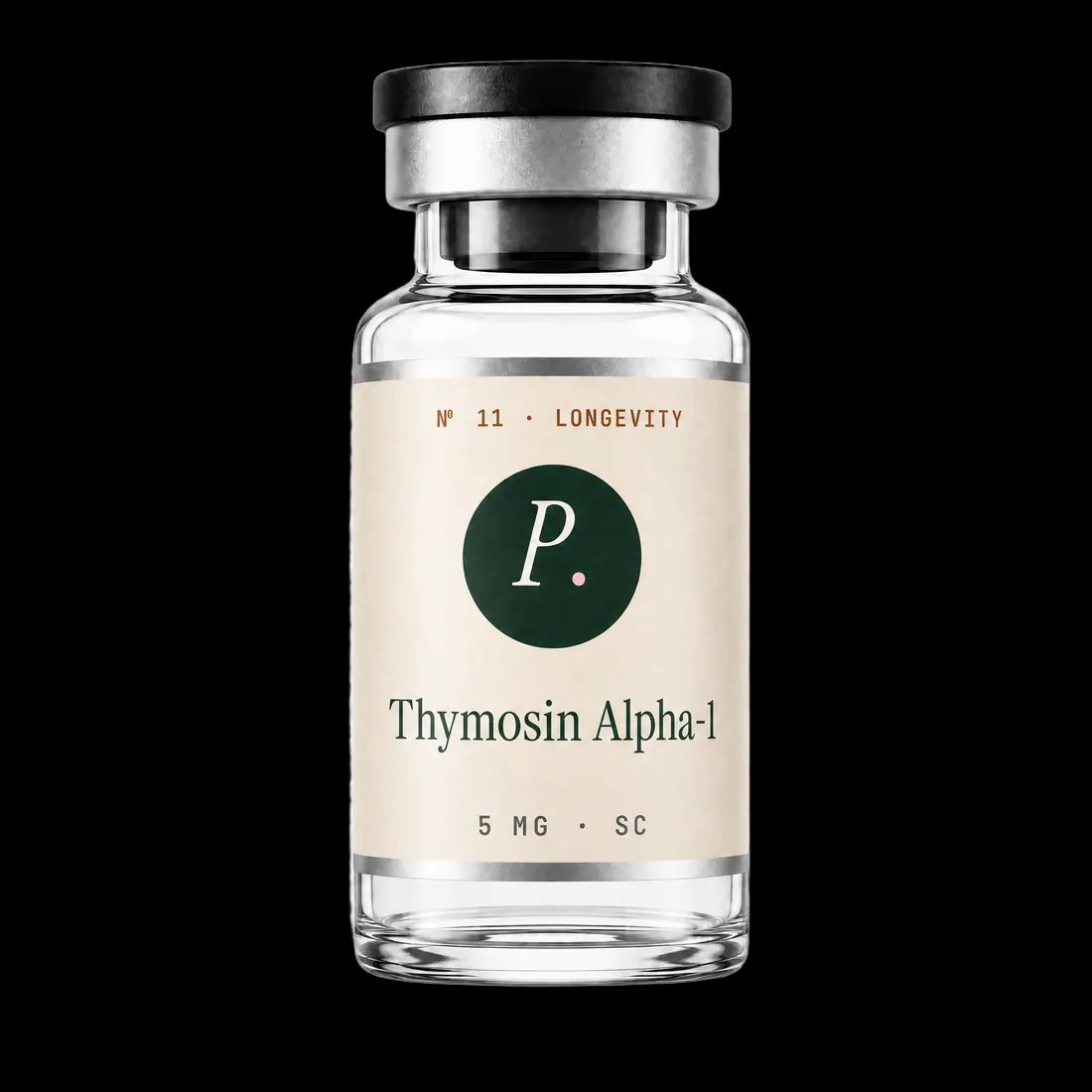
Thymosin Alpha 1 Peptide: Research, Mechanism & Product Information
Overview of Thymosin Alpha 1
Thymosin Alpha 1 (Tα1) is a 28-amino-acid peptide associated with immune-system signaling and regulation. It was originally identified in research involving thymic tissue and has since been investigated for its interactions with immune cells, including T lymphocytes and dendritic cells.
Scientific interest in Thymosin Alpha 1 centers on its potential to influence innate and adaptive immune responses. Researchers have examined its role in immune-cell communication, cytokine signaling, and selected clinical settings where immune function is relevant.
Peptika provides product information to help customers understand the scientific background, research applications, and documentation considerations associated with Thymosin Alpha 1.
Important research note: Thymosin Alpha 1 has been studied in humans for specific medical conditions, but evidence and regulatory status differ by indication and country. Findings from one clinical setting should not be generalized to other conditions or to every product sold under the same compound name.
What Is Thymosin Alpha 1?
Thymosin Alpha 1 is a short peptide consisting of 28 amino acids. Its synthetic pharmaceutical form is known as thymalfasin. The peptide is associated with biological pathways involved in immune-cell function and communication.
The immune system relies on coordinated interactions between several cell types. T lymphocytes participate in adaptive immune responses, while dendritic cells help present antigens and coordinate responses between different parts of the immune system. Thymosin Alpha 1 has been studied for its effects on these processes and on signaling molecules involved in immune regulation.
Although the peptide has been investigated in clinical studies, its effects depend on the condition being studied, the treatment context, and the particular product used. A research peptide should not be assumed equivalent to an authorized pharmaceutical product simply because it contains the same named compound.
How Does Thymosin Alpha 1 Work?
Thymosin Alpha 1 is described as an immunomodulatory peptide because research suggests it can influence multiple components of immune signaling. Its precise effects are complex and may vary with the biological context.
1. T-lymphocyte activity
T lymphocytes are important cells in adaptive immunity. Research has investigated how Thymosin Alpha 1 may influence T-cell maturation, activation, and immune-response coordination.
These observations help explain why the peptide has been studied in conditions involving altered immune function. They do not establish that using a commercial Thymosin Alpha 1 product will reliably improve immune function in otherwise healthy people.
2. Dendritic-cell signaling
Dendritic cells help identify and present antigens, supporting communication between innate and adaptive immune responses. Thymosin Alpha 1 has been studied for its potential influence on dendritic-cell function and associated signaling pathways.
Research has also explored interactions involving Toll-like receptors and downstream immune signaling. These mechanisms are an active subject of scientific investigation; they should not be interpreted as proof that the peptide prevents or treats a particular infection.
3. Cytokine and immune-response regulation
Cytokines are signaling proteins that help coordinate immune activity. Studies have investigated whether Thymosin Alpha 1 influences the production of cytokines and other mediators involved in immune-cell communication.
Immune regulation is not simply a matter of increasing immune activity. The type, timing, and magnitude of a response can be important, and an effect observed in a laboratory or specific clinical setting may not translate into a predictable benefit elsewhere.
Thymosin Alpha 1 Research Areas
Thymosin Alpha 1 has been investigated in several clinical and scientific contexts.
- Immune-system signaling: Research into interactions with T lymphocytes, dendritic cells, and immune-related signaling pathways.
- Infectious-disease research: Clinical and laboratory investigations have examined its use in selected infectious diseases. Results are not uniform across conditions.
- Cancer-related research: Studies have evaluated Thymosin Alpha 1 as an adjunct in certain cancer-care settings. It should not be represented as a stand-alone cancer treatment.
- Sepsis research: A large randomized phase 3 trial evaluated Thymosin Alpha 1 in adults with sepsis and did not demonstrate a significant reduction in 28-day mortality compared with placebo.
- Vaccine and immune-response research: Researchers have studied possible effects on immune responses in selected settings, although findings cannot be generalized to all vaccines or populations.
The existence of clinical studies does not automatically mean that a product is approved, appropriate for self-treatment, or effective for every proposed use. Evidence should be evaluated for the specific condition, formulation, and clinical context.
Thymosin Alpha 1 and Other Research Peptides
Thymosin Alpha 1 belongs to the broader field of peptide research, but it has a different biological focus from peptides investigated primarily for growth-hormone signaling, tissue biology, or metabolic pathways.
- Thymosin Beta 4: A distinct peptide studied in relation to actin regulation, cell migration, and tissue-related biology. It is not interchangeable with Thymosin Alpha 1.
- BPC-157: An investigational peptide frequently discussed in preclinical tissue-repair research; its evidence base and proposed mechanisms differ from those of Thymosin Alpha 1.
- LL-37: An antimicrobial host-defense peptide studied for its role in innate immunity and inflammatory signaling.
- MOTS-c: A mitochondria-derived peptide investigated primarily in mitochondrial signaling and metabolic research.
These compounds have different structures, research histories, and evidence limitations. Similarities in the broad field of peptide research do not establish equivalent safety, effectiveness, or regulatory status.
Product Quality and Documentation
Clear product identification and reliable documentation are essential when evaluating peptide materials. Product claims should reflect the evidence available for the specific item and batch being supplied.
Relevant documentation may include:
- Identity testing: Analytical evidence supporting the identity of the stated peptide.
- Purity analysis: Results describing measured purity and relevant impurities.
- Batch-specific records: Documentation that matches the actual batch supplied.
- Chemical form: Clear identification of the material supplied, including whether it is Thymosin Alpha 1 free base or a salt form such as acetate.
- Manufacturing and handling information: Available information about the production process, storage conditions, and handling requirements.
- Sterility and endotoxin testing: Where relevant to the intended product and route, appropriate evidence must be provided rather than assumed.
A certificate of analysis (CoA) should be reviewed for its batch identifier, analytical methods, results, and issuing laboratory. A CoA by itself does not prove that a product is sterile, approved for medical use, or suitable for injection.
Research-grade materials should not be presented as equivalent to authorized pharmaceutical formulations without appropriate evidence.
Safety and Regulatory Considerations
Thymosin Alpha 1 has been investigated in human clinical studies and has received authorization for certain uses in some countries. However, regulatory approvals are country-specific and indication-specific. Thymosin Alpha 1 is not an FDA-approved drug for general use in the United States, and regulatory treatment of compounded or research products is a separate matter from the status of pharmaceutical products authorized elsewhere.
The U.S. FDA has reviewed Thymosin Alpha 1-related bulk substances in the context of pharmacy compounding. Before marketing a product, sellers should verify the current applicable requirements, the precise chemical form, and the claims permitted in each target market.
Clinical evidence also requires careful interpretation. In the large TESTS phase 3 trial involving adults with sepsis, Thymosin Alpha 1 did not significantly reduce 28-day mortality compared with placebo. Other studies have examined different conditions and treatment combinations, but the evidence is not uniform.
Important safety note: Do not describe Thymosin Alpha 1 as a proven immune booster, infection cure, cancer treatment, or substitute for medical care. Do not assume that research-grade material is suitable for human administration. Medical decisions involving immune-modulating substances should be made with a qualified healthcare professional.
Frequently Asked Questions About Thymosin Alpha 1
What is Thymosin Alpha 1?
Thymosin Alpha 1 is a 28-amino-acid peptide studied for its influence on immune-cell function and signaling. Its synthetic pharmaceutical form is known as thymalfasin.
What is Thymosin Alpha 1 studied for?
Research has examined its potential role in immune modulation, selected infectious diseases, cancer-related adjunctive care, and other clinical settings. Evidence differs by condition, and research findings should not be treated as proof of a general therapeutic benefit.
Is Thymosin Alpha 1 the same as thymalfasin?
Thymalfasin is the name used for the synthetic pharmaceutical form of Thymosin Alpha 1. However, a product sold as Thymosin Alpha 1 should not automatically be assumed to be equivalent to an authorized thymalfasin medicine. Manufacturing standards, formulation, quality controls, and regulatory status matter.
Does Thymosin Alpha 1 boost the immune system?
It is more accurate to describe Thymosin Alpha 1 as an investigational or context-dependent immunomodulatory peptide. Research suggests that it can influence immune signaling, but this does not prove that it safely or reliably improves immune function in healthy people.
Is Thymosin Alpha 1 FDA-approved?
Thymosin Alpha 1 is not FDA-approved for general use in the United States. It has been authorized for certain indications in some other countries. Always check the current regulatory status for the specific product and jurisdiction.
Is Thymosin Alpha 1 proven to treat sepsis?
No. In a large randomized phase 3 trial, Thymosin Alpha 1 did not significantly reduce 28-day mortality in adults with sepsis compared with placebo. Sepsis is a medical emergency requiring immediate hospital care.
Is Thymosin Alpha 1 the same as Thymosin Beta 4?
No. They are distinct peptides with different biological characteristics and research histories. Information about one should not be used to make claims about the other.
What should I check when evaluating a Thymosin Alpha 1 product?
Review the precise compound and chemical form, batch-specific identity and purity documentation, relevant manufacturing information, and applicable regulatory status. Claims about sterility or suitability for a particular route of administration require appropriate supporting evidence.
Conclusion
Thymosin Alpha 1 is a scientifically studied immunomodulatory peptide with a substantial research history involving immune-cell signaling and selected clinical settings. Its research profile is more clinically developed than that of many experimental peptides, but the strength of evidence varies by indication, and not all clinical trials have demonstrated benefit.
Peptika aims to provide clear, responsible product information that distinguishes research findings from established medical uses. Customers should assess the documentation available for the specific product and avoid interpreting scientific interest as proof of safety or effectiveness.
Disclaimer: This content is for general educational and scientific information only. It is not medical advice and does not diagnose, treat, cure, or prevent any disease. Regulatory status and permitted uses vary by country and product. Research materials should not be assumed suitable for human administration. Consult a qualified healthcare professional for medical questions and verify applicable legal and regulatory requirements before making decisions involving peptide products.

Reviews
There are no reviews yet.